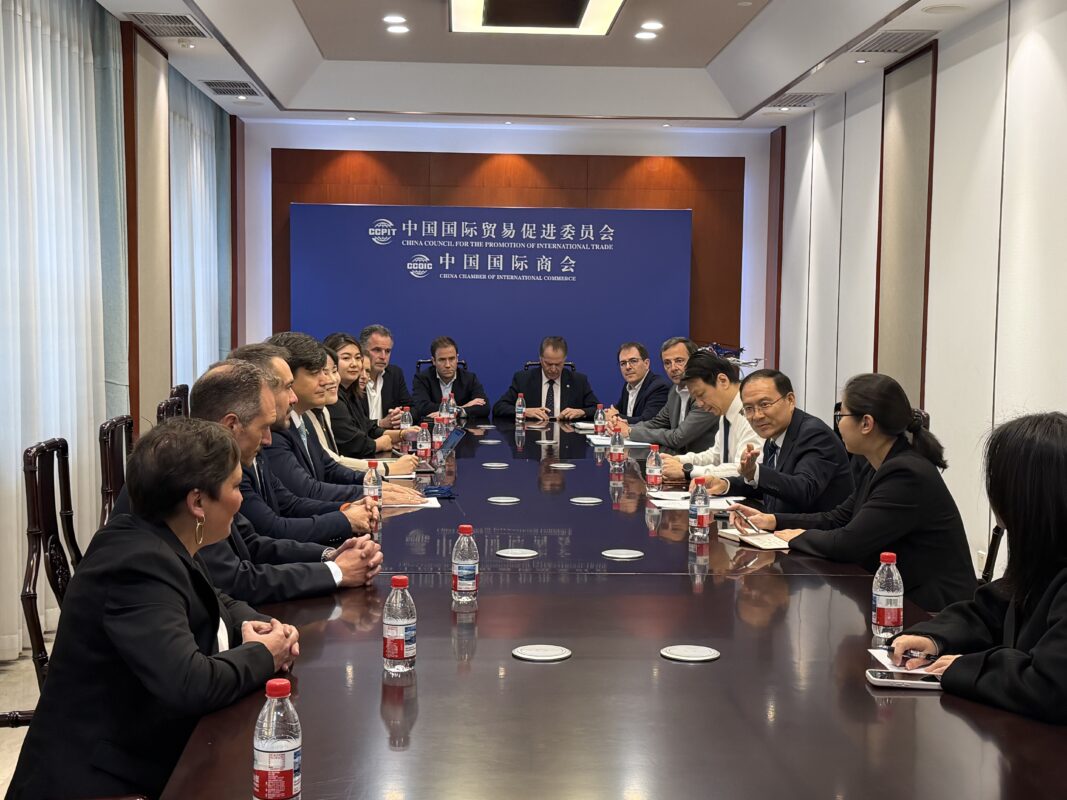
On November 16, Dang Hong, Vice Secretary of the Party Committee of the International Chamber of Commerce of China (CCIC), met in Beijing with the delegation of the Government of the Principality of Asturias (Spain). Both parties exchanged views on deepening China-Spain economic and trade cooperation and on boosting industry, innovation, and resource connectivity. Representatives of the Association for Industrial and Engineering Cooperation Spain-China (ACIIEC), as well as representatives of companies and institutions accompanying the delegation, including EDP Spain, FCC Ámbito, Gestlink, and the Chamber of Commerce of Gijón, attended the meeting.
The Asturian delegation was composed mainly of members of the Government. The meeting was attended by the head of the delegation, Borja Sánchez García, Councilor for Science, Industry and Employment of the Principality of Asturias; José Antonio Sicre Artalejo, Director of the Economic Office of the Presidency of the Government of the Principality; David González Fernández, Executive Director of the Agency for Science, Business Competitiveness and Innovation (SEKUENS); Verónica Noval Gutiérrez, Chief of Staff of the Councilor; and Blanca Adela Gutiérrez Pérez, Head of Communication of the Ministry.
Dang Hong welcomed the delegation. He noted that Spain is an important strategic partner of China in the European Union and that bilateral economic and trade relations maintain a good dynamic, with close trade and investment exchanges and ever-growing cooperation spaces at the regional and industrial levels.
The Chinese Council for the Promotion of International Trade (CCPIT) was presented as the trade, investment and industry promotion body linked to the State Council, with the mission of connecting institutions and enterprises, articulating the national and international spheres, and facilitating supply and demand. Its activity focuses on four axes: trade promotion, investment and industry; legal services in trade; participation in global economic governance; and development of applied think tanks. The China International Chamber of Commerce (CCIC), as the essential platform for its work, currently has more than 350,000 members, which bring together the vast majority of central enterprises, national financial institutions, and a large group of renowned private and foreign-capital enterprises. The CCOIC has been creating channels of connection for Chinese and foreign companies through visits by delegations, exhibitions, forums and sectoral meetings, and maintains institutional cooperation with other chambers and associations, offering services in the fields of international exchange, sectoral cooperation, legal advice, market information, the organization of trade fairs, project acquisition and business training. Spanish companies that encounter difficulties in their activity in China can turn to the Chamber at any time, which will help coordinate their resolution. The Chamber aims to become an important bridge for economic and commercial cooperation between Chinese and Spanish companies.
Dang Hong indicated that the Principality has a complete industrial base and a solid research and innovation capacity, with a high degree of alignment with China's priorities of green and low-carbon transition, circular economy, and strengthening collaboration between academia, research, and business. The Chinese side welcomes Asturian companies taking advantage of the opportunities in the large-scale Chinese market and expanding their activities in the country, and also supports Chinese companies with conditions to invest and develop in Asturias. He added that next year the Fifth International Exhibition of China for the Promotion of Supply Chains (CISCE) and the XX China-EU Investment, Trade and Technology Cooperation Conference will be held; two platforms ideal for Asturian government, companies and academic institutions to participate with priority sectors and projects; the Chamber is ready to help companies from both sides connect the links of industrial chains.
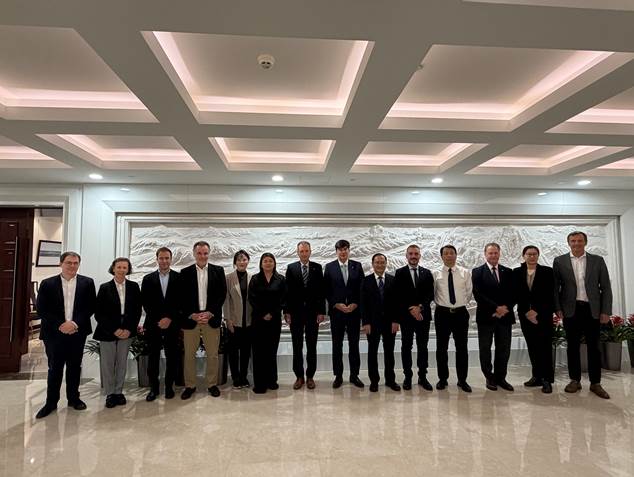
Borja Sánchez García presented the situation of the Principality of Asturias. Located in the northwest of Spain, it has a population of around 1.01 million inhabitants; the cities of Oviedo, Gijón and Avilés, relatively close to each other, form Spain’s seventh metropolitan area. Its airport maintains connections with the main European cities and is within easy flight distance from Madrid and Paris. As one of the country’s traditional industrial regions, the Principality possesses a solid base in the steel industry, metal processing, chemical industry, energy and the manufacture of equipment. The ports of Gijón and Avilés play an important logistical role, and the ZALIA, the logistics and industrial activity zone of Gijón, is already meeting the conditions for the integration between port and industry; currently more than 150 multinationals are already established in the territory.
He added that the Principality is promoting energy transition and reindustrialization, with priority given to new energy sources and storage, the value chain of electric vehicles and advanced manufacturing, while promoting the reuse of old industrial spaces and the construction of high-quality industrial parks. Research and innovation centers, technology centers, and the University of Oviedo support this transformation. Most of the Asturian territory is protected land, and industrial deployment is concentrated in a relatively orderly manner, which is attractive to companies committed to sustainability criteria. He expressed his desire to take this meeting as a starting point to, through the channels of the CCPIT and its Representative Office in Spain, establish stable contacts with the Chinese industrial sector and promote business cooperation in clean energy, circular economy, and advanced materials.
Both parties agreed that China and Asturias present strong complementarities and broad prospects for cooperation in green energy, circular economy, advanced materials, port logistics, education and research. The China International Chamber of Commerce is ready to fully deploy its resources as a platform to continue promoting the exchange and mutual learning between the Chinese business sector and the Principality of Asturias, consolidate consensus and generate more results in bilateral trade and investment. For its part, the Principality expressed that it will maintain regular communication with the CCPIT and its Representative Office in Spain, so that cooperation moves from an exchange to a formalized and concrete relationship and contributes to deepening economic and trade cooperation between China and Spain.
 Español
 简体中文
 English