Zhu Haoliang ACCU Flag of Asia Research Institute
From Chery's pioneering presence in Spain to the confirmed rumors of Geely acquiring Ford's Spanish plant, and the subsequent intensive deployment of companies like SAIC MG, Changan, Leapmotor, and CATL, Spain is rapidly becoming a key gateway for the Chinese new energy vehicle value chain in Europe. Spain is no longer just a major target market for Chinese automakers, but is transforming into a genuine European production hub for them.
Someone asked: Why Spain? And why now, precisely?
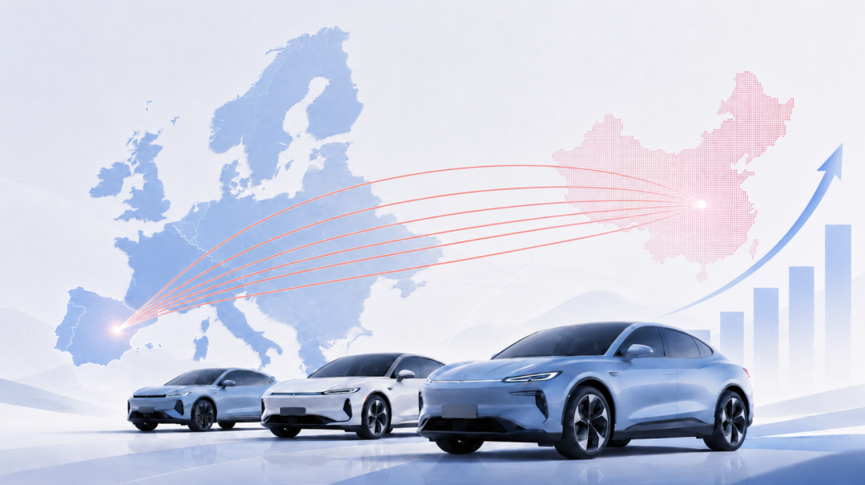
To answer the previous question, let's first look at some data. China's car exports to the European market increased from 10,000 vehicles in 2019 to almost 1 million vehicles in 2025, in just 6 years.
In the last two years, China's car exports to Europe have undergone a radical transformation.
In 2024, China maintained its leading position in global vehicle exports. In 2025, Chinese automobile exports reached 8.32 million units, a 30% increase compared to 2024. When considering new energy vehicles separately, Chinese exports of this type of vehicle reached 2.56 million units in 2025, more than double the 1.27 million units exported in 2024. Regionally, Chinese automobile exports to Europe, the CIS, and the Middle East and West Asia were the most significant.
As 2026 begins, the momentum in exports is even stronger. In the first quarter of 2026, China’s automobile exports reached 2.34 million units, representing a year-over-year increase of 53% compared with the same period in 2025. .
In the European market, Chinese automakers have performed particularly well. Data from the market research firm Dataforce shows that monthly sales by Chinese automakers in Europe exceeded 100,000 units for the first time in 2025, reaching 109,900 units—a year-over-year increase of 127%— with a market share of 9.51%, compared to just 4.51% in the same period of 2024. Looking at the full year, Chinese automakers sold 811,000 vehicles in the European market, a year-over-year increase of 99%, with a market share of 6.1%, up from 3.1% in 2024. The French newspaper La Croix, citing data from Inovev Consulting, also confirms this trend: since 2024, the number of cars exported from China to Europe has exceeded the number exported from Europe to China, and by 2025, this figure had tripled, reaching a total of 620,000 units, of which 504,000 came from Chinese automakers.
In the pure electric vehicle market across 15 key European countries, Chinese brands achieved a market share of 14.97%, more than double the 6.81% recorded in the same period of 2025. Including Chinese brands operating in Europe, the market share of Chinese electric vehicles rose to 21.68% in the first quarter. In terms of brand performance, BYD surpassed European giants such as BMW, Audi, and Mercedes-Benz for the first time in the first quarter, ranking among the top five European electric vehicle brands.
Top 5 Chinese brands in the European market
According to market data, the sales figures for several leading Chinese car brands in Europe in 2025 are as follows:
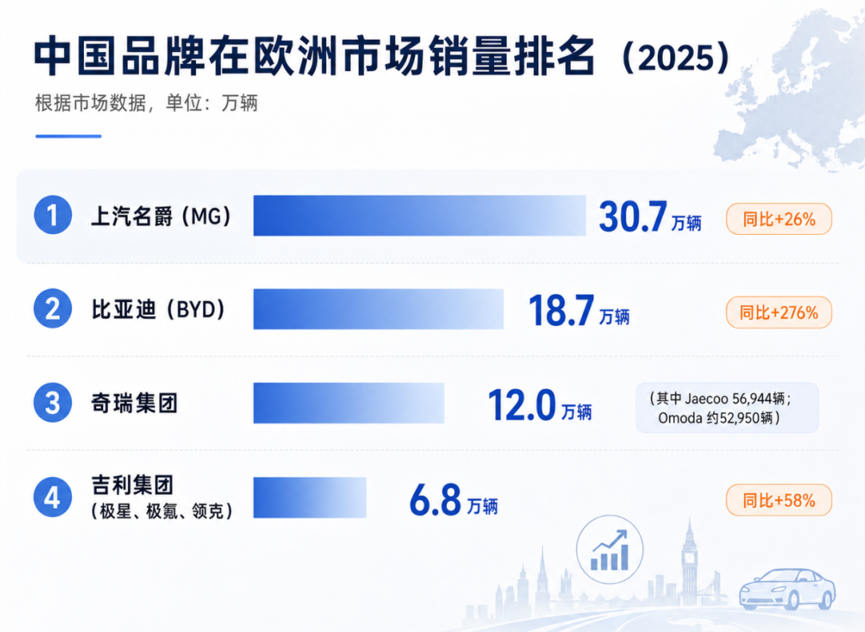
- SAIC MG . In 2025, it sold 307.000 vehicles, a year-over-year increase of 261% in the third quarter, making it the only Chinese car brand in the top 20 of the European market, ranking 16th. MG’s European director previously stated that, with annual sales of approximately 300,000 vehicles in Europe, building a local factory is economically viable.
- BYD reached 187,000 vehicles in 2025 (including the Denza), representing a year-over-year increase of 276%, and its ranking rose from 31st place in 2024 to 22nd place in 2025. .
- Chery Group . Chery's total sales across all its brands in Europe reached 120,000 vehicles in 2025, a figure significantly higher than the 17,000 vehicles sold in 2024. Of these, Jaecoo sold 56,944 vehicles and Omoda approximately 52,950. .
- Geely Group (Polestar, JK, Lynk & Co) . Geely's brands sold 68,000 vehicles, a year-over-year increase of 581% in the third quarter. Polestar sold 47,579 vehicles, a year-over-year increase of 561% in the third quarter. .
By 2025, EU trade in automobiles and auto parts with China will reach 22 billion euros, an increase of 8% compared to 2024. In stark contrast, EU automobile exports to China have plummeted by 34%, a drop of more than half compared to 2022. .
Behind the impressive growth figures, hidden concerns are also accumulating simultaneously.
In October 2024, the EU issued its final ruling against subsidies for Chinese electric vehicles, imposing additional tariffs of up to 35.31% on top of the existing 10.1% tariff. Some MG models faced a combined tariff of up to 45.31%. This means that even a car with well-controlled costs in China instantly loses its profitability in the European market after factoring in shipping costs and tariffs. Furthermore, given that the EU is currently debating the proposed International Autonomy Act (IAA), the »local content» principle will be tightened even further; simply assembling a car on European soil will no longer be sufficient for it to be considered »Made in Europe.» .
Tariffs and regulations have forced automakers to localize production, and this logic has become fully effective. If you're going to build walls around your city, then I'll build within. Spain, in particular, is one of Europe's most fertile lands for growing cars. .
Why Spain? — Six advantages that Chinese car manufacturers cannot ignore. .
The concentration of Chinese car manufacturers in Spain is no coincidence. Six key advantages, in combination, make Spain an unmissable choice.
First of all, Spain is one of the few Countries of Europe What supports new energy vehicles .
While some European countries are hesitant to invest in Chinese new energy vehicles, Spain has opened its doors. The Spanish stance is very pragmatic: the European automotive industry is undergoing a major transformation, while China possesses the most complete new energy industry value chain in the world. Instead of being mere spectators, it is better to proactively leverage China's strengths.
At the groundbreaking ceremony for CATL's factory, the Spanish Minister of Industry and Tourism, Jordi Hereu, stated bluntly that this investment «reinforces Spain's position as a center for sustainable production in Europe.» During his fourth visit to China in April 2026, Spanish Prime Minister Sánchez specifically met with Zhu Huarong, Chairman of Changan Automobile, and other senior executives from Chinese companies, demonstrating Spain's clear stance on attracting Chinese investment. Spain's attitude—welcoming Chinese investment, factories, and technology in Europe—stands in stark contrast to that of most European countries. .
Secondly, Spain has the most established automotive industrial base in Europe.
Spain is Europe's second-largest automobile producer, after Germany. In 2025, its total production reached 2.27 million vehicles, of which approximately 1.96 million were exported, representing 86.11% of total production. It ranks ninth globally. The country has 17 vehicle manufacturing plants and more than 1,000 suppliers of specialized parts, which account for 75% of a vehicle’s value. Multinational giants such as Volkswagen, Stellantis, Ford, and Renault have major factories in Spain, forming a comprehensive industrial ecosystem that spans the Catalonia–Aragon–Navarre–Basque Country manufacturing corridor, the Vigo cluster in the northwest, and the Valencia cluster in the east. The local parts supply chain is robust and includes international suppliers such as Gestamp (stamping and body structure), CIE Automotive (metals and lightweighting), Antolin (interior and exterior trim), and Ficosa (on-board electronics and smart cockpit). In addition, neighboring countries such as France and Morocco also have strong capabilities for supplying parts to the automotive industry. This means that Chinese automakers entering Spain do not need to build their supply chains from scratch but can integrate directly into a mature industrial ecosystem.
Thirdly, Spain has one of the most important logistics centers in Europe.
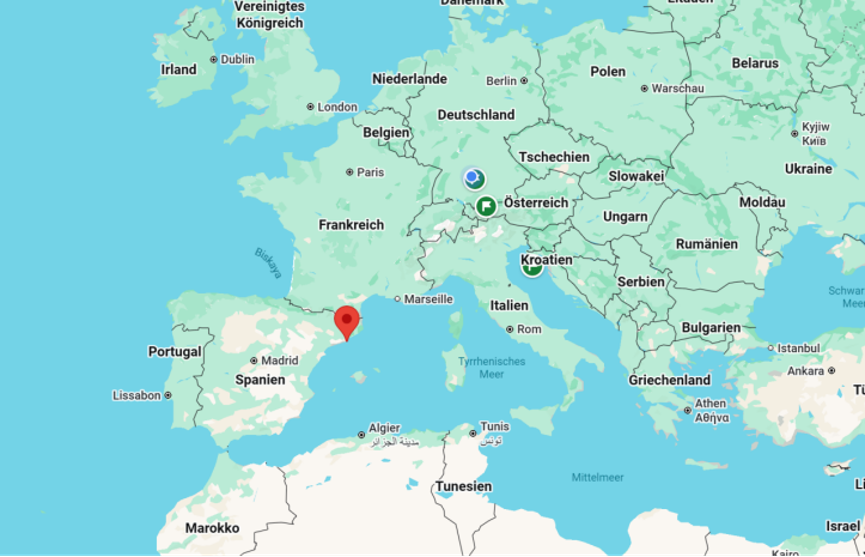
Spain's geographical location is of vital strategic importance. It boasts deep-water ports such as Barcelona, Valencia, and Bilbao, which provide efficient connections to mainland Europe while simultaneously projecting its influence towards North Africa and Latin America. Spain possesses the most extensive highway network in the EU, leading to highly efficient logistics. This not only reduces transportation costs but also makes Spain aexport hub for European and global markets. For Chinese automobile manufacturers, factories in Spain can not only supply the EU market but also serve as a gateway to Latin America and Africa. .
Fourthly, manufacturing costs are significantly lower than in Germany and France.
Compared to Germany and France, Spain offers lower labor and land costs, along with greater government subsidies. It also enjoys a significant advantage in electricity costs compared to other major European industrialized nations. For any company looking for economies of scale, this represents significant financial advantages.
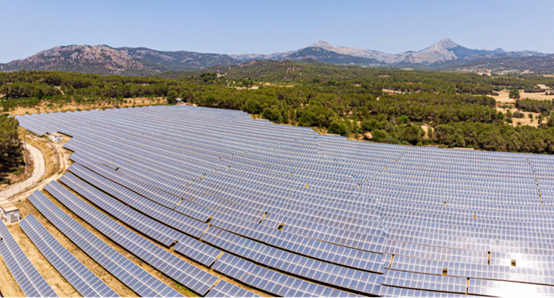
Furthermore, Spain is one of the few regions in the EU that can simultaneously offer a great abundance of renewable energy and relatively competitive electricity prices. With an average of over 2,000 hours of sunshine per day and a strong foundation for the rapid development of photovoltaic power generation, Spain is an ideal location for the southward relocation of electric vehicle manufacturing centers.
Fifth, it has a highly experienced team in the automotive industry.
As a traditional powerhouse in European automotive manufacturing, Spain has accumulated a strong and stable reserve of skilled labor. During a project I conducted in Spain in 2016, I was able to observe that many Spanish auto parts companies possessed high levels of automation and digital management capabilities. Spain also offers a comprehensive training and certification system for skilled workers, providing a broad talent pool for new professionals. These industrial advantages, both tangible and intangible, are something no car manufacturer can buy with money.
In sixth place, and most importantly , The EU's tariff pressure is driving local production.
Exporting to Europe is becoming increasingly difficult; the transition to local production, local supply chains, local employment, and local certification is no longer an option, but a necessity. Spain offers the best starting point. As Leapmotor and Geely's decisions demonstrate, local production allows for direct access to the main European market, decisively bypassing trade barriers that affect products originating from China.
In conclusionón
Spain is becoming a key gateway for China's new energy vehicle industry into Europe. From the start of production at the Chery joint venture factory in Ebro to Geely's acquisition of Ford's Spanish production line, from the planned construction of SAIC MG's factory to Leapmotor's cooperation through Stellantis, from the construction of the €4.1 billion CATL joint factory to Envision Power's establishment of the first European zero-carbon industrial park, this list continues to grow.
By 2025, Chinese brands will have captured more than 10% of the Spanish market share, reaching 14% in March 2026, with an 8.91% year-over-year increase in sales. Behind these figures lies the true progress of China’s new energy vehicle industry in the European market.
This is not simply a transfer of production capacity, but a structural transformation of the Chinese automotive industry, moving from exporting products to exporting the industry itself. Producing locally, utilizing local supply chains, employing local workers, and serving local markets: this is an irreversible path and an essential step for the true globalization of the Chinese automotive industry. I wish for Chinese companies to achieve sustainable, high-quality, and long-term development in Spain; while promoting local economic development, we must also integrate well, tell China's story effectively, and promote Chinese culture. .
 Español
  简体中文
简体中文  English